| Tel. (800) 647-8217 | |||||||
Western & Native American Art prints |
Free insured shipping | ||||||
| on U.S. orders over $100 | |||||||
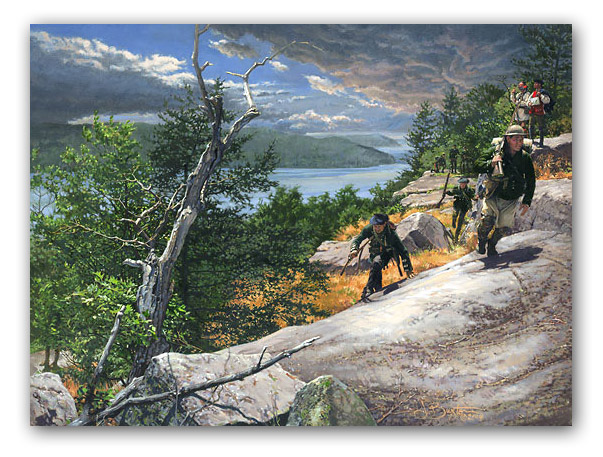
Rogers Rangers Toward Ticonderoga
by John Buxton
If the enemy pursue your rear, take a circle till you come to your own tracks, and there form an ambush to receive them, and give them the first fire. If your number be small, march in a single file, keeping at such a distance from each other as to prevent one shot from killing two men. In this painting by John Buxton, it is the summer of 1759, and France and Great Britain are locked in their final struggle for supremacy in North America. A scouting party led by the famous Robert Rogers pauses atop Mount Pelee, overlooking Lake George, on its way to observe Once the Rangers' proficiency was recognized, they became Independent Companies on the Regular British Establishment, and they were paid for by the Crown. Their dress was a distinctive combination of military, frontier, and native styles, and they practiced then-unconventional tactics. The Rangers are accompanied by Royal Artillery Lieutenant Thomas Davies, whose artistic efforts left us a valuable record of colonial America. A member of Rogers' Stockbridge Indian Companies accompanied him in this mission. He was subject to Ranger discipline, but wore native dress and served under his own Indian officers. |
| Available in the following editions | Signed by the artist |
| Edition size: | 450 | Paper print | Image size: 18" x 24" | $145 |
 |
Receive your print fully framed and ready to display. Please call or email us for a custom framing quote. |